
Coming soon · Release date TBA
UpdatedThe Witcher IV Tech Demo: PS5 Performance Explained
The Witcher IV tech demo runs at 60 FPS on a standard PS5 with ray tracing. Explore its forests, crowds, animation, and what this build means for players.
Jump to
Does the Demo Run at 60 FPS on PS5?
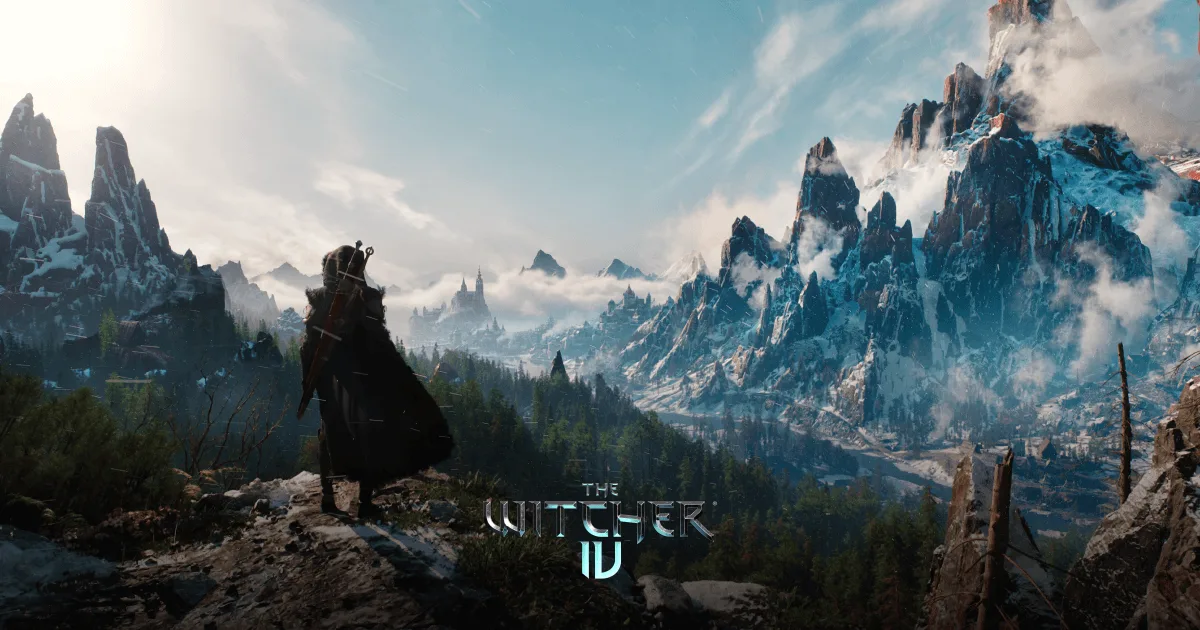
The Witcher IV tech demo runs on a standard PlayStation 5 at 60 FPS with ray tracing. It brings dense forests, horseback travel, and a crowded town into one Unreal Engine 5 showcase. This is a demonstration of technology being developed for Ciri’s adventure, separate from the finished game’s gameplay.
That distinction matters when judging performance. The build demonstrates how specific rendering, animation, and world-loading systems work together on console hardware. Its 60 FPS performance belongs to this showcase.
June 3, 2025 Showcase Details
| Feature | Demonstrated in this build |
|---|---|
| Hardware | Standard PlayStation 5 |
| Frame rate | 60 FPS |
| Lighting | Ray tracing enabled |
| Crowd demonstration | Over 300 animated skeletal mesh agents |
| Setting | Kovir, including the port town of Valdrest |
| Engine | Unreal Engine 5 |
The technical challenge extends beyond drawing a detailed landscape. Ciri and Kelpie need responsive movement, the environment needs to load during travel, and townspeople need to animate and react while everything stays within the frame budget.
Official page: The Witcher 4 (thewitcher.com)
How Nanite Foliage Handles Kovir’s Forests
Kovir’s dense woodland gives Nanite Foliage a demanding job: render detailed vegetation across a large landscape while keeping memory use and rendering costs manageable.
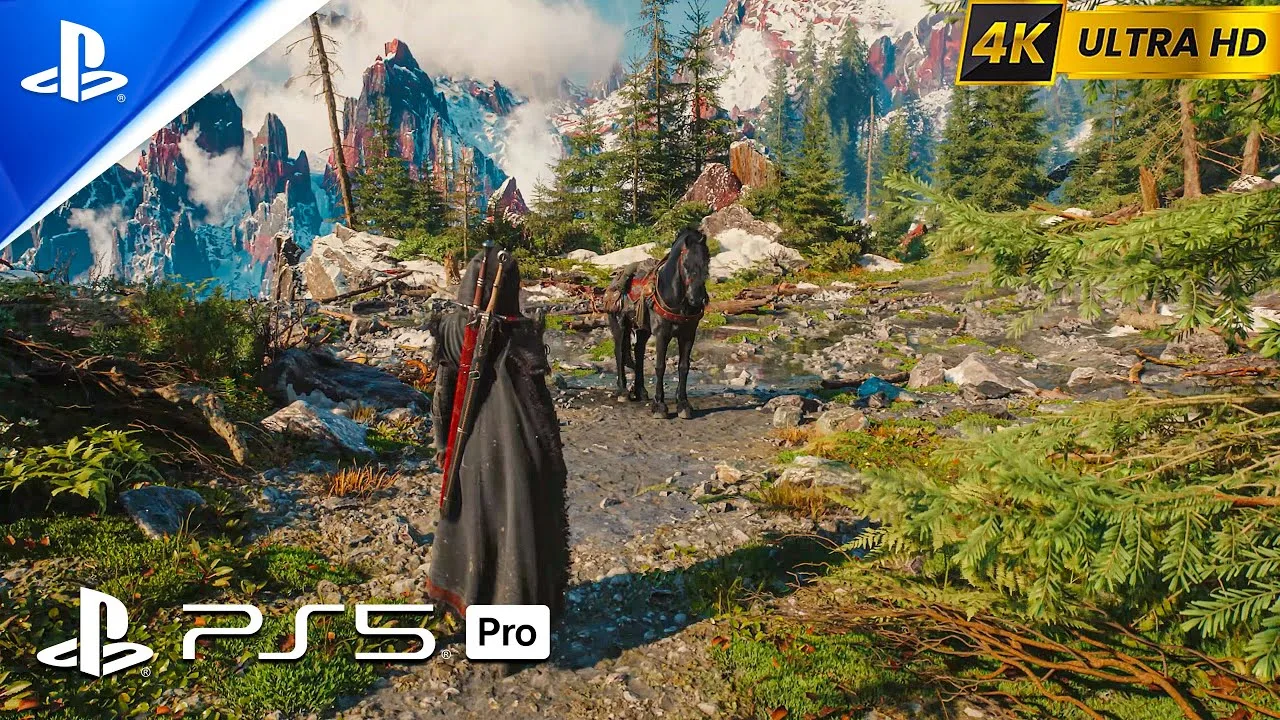
The system supports trees modeled with individual leaves and pine needles. At greater distances, Nanite uses an adaptive voxel representation, turning dense geometry into small, three-dimensional volumes that can become no larger than a pixel on screen. These distant representations still respond to changing sunlight and shadows.
For players, the useful result is a forest that retains its density as the view opens up. The technology addresses how vegetation looks both nearby and across the landscape, where simplifying thousands of small branches and needles becomes essential.
Look across the distant tree line as well as at nearby branches when assessing the forest sequence. Both views matter to how convincing Kovir feels during exploration.
Fast Geometry Streaming Keeps Travel Moving
A detailed world also needs to arrive quickly enough to keep up with the player. Fast Geometry Streaming, also called FastGeo Streaming, handles loading static geometry through a lightweight process for registering and unregistering assets.
The showcase puts that system to work during the rapid camera journey through Kovir and toward Ciri outside Valdrest. Mountains, forests, and settlement geometry load smoothly through the demonstrated route, without visible stuttering or object pop-in.
This tackles a different performance problem from foliage rendering. Nanite helps manage what gets drawn; streaming helps bring the necessary world geometry into place as the viewpoint moves.
That distinction is especially relevant to horseback exploration. Faster movement changes which parts of the world need to be ready, making smooth loading an essential part of the ride.
Why Ciri and Kelpie Move Together More Naturally
Kelpie’s animation combines several systems, each addressing a different part of riding.
- Multi-character motion matching synchronizes Ciri and Kelpie during mounting from different angles and at different speeds.
- Root motion supports Kelpie’s grounded movement.
- ML Deformer and Chaos Flesh improvements help reproduce muscles moving and stretching beneath her skin.
The mounting transitions are particularly useful to watch. Two characters need to meet at the right position and timing while responding to how the rider approaches. Synchronizing their movement helps the transition flow into travel.
The muscle deformation adds detail beneath that larger movement. ML Deformer uses high-fidelity data to approximate complex shape changes efficiently in real time, allowing Kelpie’s body to flex as she moves without the cost of reproducing the full underlying simulation.
Valdrest’s Crowds Put Animation and Reactions to Work
Valdrest tests performance through activity. Fishmongers serve customers, an innkeeper ejects a Gwent cheat, and a performance draws a substantial crowd.
The crowd demonstration includes over 300 animated skeletal mesh agents. The Unreal Animation Framework helps fit those characters into the showcase’s 60 FPS budget while retaining room on the game thread for additional gameplay systems.
Animation and crowd behavior have separate jobs here. The animation framework supports blending, state machines, and procedural animation workflows. Mass Framework manages crowd simulation and AI behavior, while Smart Objects support interactions with the environment.
The dropped apples provide a concrete example of those systems connecting. Ciri bumps into a man carrying a crate; he loses his footing, apples tumble downhill, and children and pigs react to the unexpected opportunity.
Follow that chain of events when watching the market sequence. It demonstrates how a small collision can change what nearby characters do. MetaHuman tools and Chaos Cloth also contribute to the market’s character detail, helping narrow the visual gap between Ciri and the people around her.
Kovir, Ciri’s Contract, and the Planned 2028 Release
The showcase follows Ciri through Kovir, a region making its debut in the game series. Her route leads from rugged mountains and forests into Valdrest, a port town built around fishing, freight, and mining. The closing view introduces Lan Exeter.
Ciri’s contract gives the journey its Witcher flavor. Destroyed wagons, a suspicious salt shipment, and a merchant with his own interests turn the return to town into more than a tour of scenery. A manticore connects the monster investigation to the merchant’s missing cargo.
The Witcher IV is a single-player, open-world RPG with Ciri as its protagonist. Its planned release window is 2028, following CD PROJEKT RED’s September 2, 2026 announcement. The game is being developed with customized Unreal Engine 5 technology, with the collaboration’s open-world features intended to support PC, PlayStation, and Xbox.
Continue with
 The Witcher IV Unreal Engine 5: PS5 Performance GuideThe Witcher IV Unreal Engine 5 demo runs at 60 FPS on PS5 with ray tracing. Explore foliage, crowds, streaming, and what this showcase means for players.
More in Performance
See all PerformanceContinue exploring
Join the community
Official channels for news, updates and player help: